Artificial intelligence is no longer a technology reserved for large companies or technology teams. In 2026, AI in digital marketing has become an important part of how businesses attract customers, create content, manage advertising campaigns and improve customer experiences.
From generating marketing ideas and analyzing customer behavior to optimizing advertisements and automating lead follow-ups, AI can help marketing teams work faster and make better decisions.
However, the biggest opportunity is not simply using AI to produce more content. The real advantage comes from combining AI-powered insights with human creativity, strategy and brand understanding.
For startups, small businesses and growing brands, this can mean doing more with limited budgets while creating more personalized experiences for potential customers.
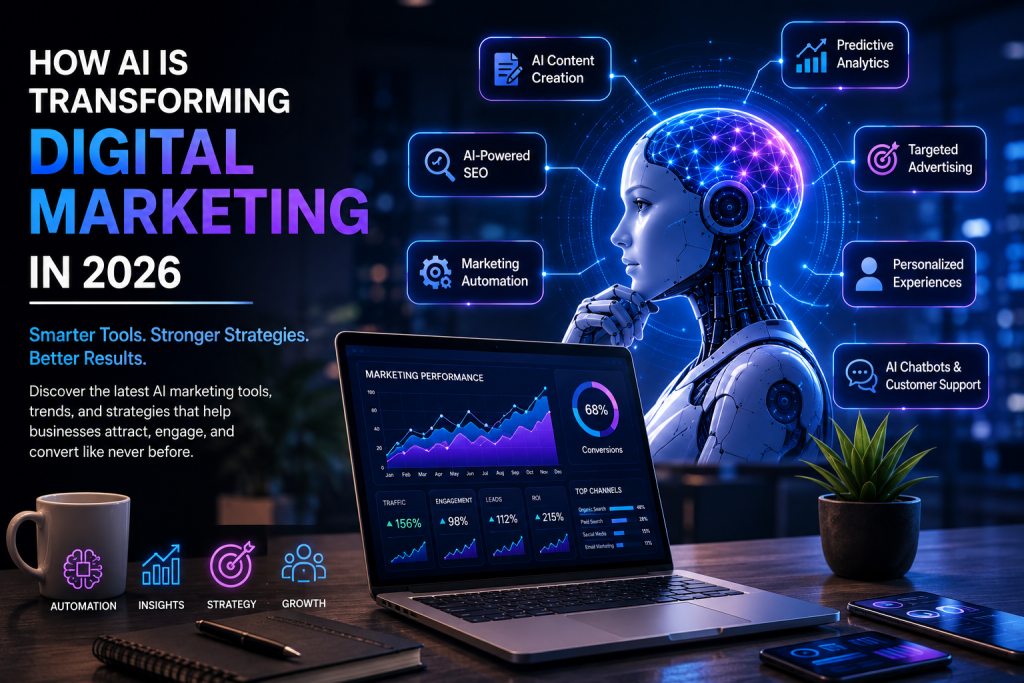
So, how exactly is AI transforming digital marketing in 2026?
1. AI Is Making Digital Marketing More Personalized
Customers increasingly expect brands to understand their needs and preferences.
Traditional marketing often delivers the same message to a broad audience. AI can analyze customer behavior, interests, previous interactions and engagement patterns to help marketers create more relevant experiences.
For example, AI can help businesses:
- Recommend relevant products or services
- Personalize email campaigns
- Segment audiences
- Identify customer interests
- Deliver customized website experiences
- Create different advertising messages for different audiences
This level of personalization can make marketing communication more relevant and improve customer engagement.
2. AI Is Changing Content Creation
Content remains one of the foundations of digital marketing, but the way content is produced is changing rapidly.
Modern AI marketing tools can assist marketers with brainstorming, research, outlines, social media captions, ad variations, email ideas, video scripts and other repetitive tasks.
The important point is that AI should be treated as a marketing assistant, not a replacement for the marketer.
A strong workflow can look like this:
AI generates ideas → marketer adds expertise → brand voice is refined → facts are reviewed → content is published → performance is analyzed.
This approach allows businesses to increase content production without sacrificing originality and brand personality.
3. AI Is Transforming SEO
Search engine optimization is also evolving with artificial intelligence.
AI-powered SEO tools can help marketers identify keyword opportunities, analyze competitors, understand search intent, improve content structure and identify optimization opportunities.
But SEO in 2026 is no longer only about inserting keywords into an article.
Businesses need to create content that clearly answers customer questions, demonstrates expertise and provides genuine value.
Another important development is the growth of AI-powered search and answer engines. Consumers are increasingly using AI platforms to research products, services and businesses.
That means brands need to think beyond traditional rankings and work toward becoming a reliable source that AI-powered search experiences can understand and reference.
This creates an emerging opportunity for businesses to combine traditional SEO with AI search optimization.
4. AI Is Making Paid Advertising Smarter
Digital advertising platforms already use machine learning and automation to optimize campaigns.
AI can assist with:
- Audience targeting
- Bid optimization
- Budget allocation
- Creative testing
- Conversion prediction
- Campaign analysis
- Ad personalization
For businesses running Google Ads or social media advertising, this can help identify which audiences and creative combinations are producing better results.
However, automation does not eliminate the need for strategy.
Marketers still need to determine the right offer, positioning, audience, messaging and conversion goal.
AI can optimize the campaign, but a poor marketing strategy cannot be rescued simply by adding AI.
5. AI Chatbots Are Improving Lead Generation
One of the most practical applications of AI for businesses is conversational marketing.
AI-powered chatbots can interact with website visitors, answer common questions, collect customer information and help qualify leads.
For example, instead of asking visitors to fill out a generic contact form, an AI chatbot can ask:
“What service are you interested in?”
It can then collect additional information and direct the potential customer toward the appropriate next step.
For service-based businesses, this can create a faster path between website visitor → qualified lead → sales conversation.
AI chatbots can also provide assistance outside normal business hours, giving businesses an opportunity to respond to prospects even when the marketing or sales team is unavailable.
6. AI Is Automating Repetitive Marketing Tasks
Marketing teams spend significant time on repetitive activities.
AI automation in marketing can reduce manual work across areas such as:
- Email follow-ups
- Lead qualification
- Customer segmentation
- Social media workflows
- Reporting
- Data analysis
- Campaign monitoring
- Content repurposing
For example, one long-form blog can be transformed into multiple social media posts, email content, short-video ideas and promotional messages.
This allows marketers to spend more time on activities that require human judgment, creativity and strategic thinking.
7. Predictive Analytics Helps Businesses Make Better Decisions
One of the biggest advantages of AI is its ability to analyze large amounts of data.
Instead of simply looking at what happened in the past, AI-powered analytics can help businesses identify patterns and predict possible customer behavior.
Marketing teams can use predictive insights to understand:
- Which leads are more likely to convert
- Which customers may stop engaging
- Which campaigns are performing best
- Which audiences have higher purchase potential
- Where marketing budgets may generate better returns
This makes marketing more data-driven and can help businesses make decisions based on evidence rather than assumptions.
8. Social Media Marketing Is Becoming More Intelligent
Social media marketers can use AI throughout the content and campaign workflow.
AI can help generate content ideas, identify audience interests, analyze engagement patterns, suggest content formats and assist with campaign optimization.
But successful social media marketing still depends heavily on authenticity.
Audiences do not simply want more content. They want content that feels relevant, useful and human.
The strongest strategy is therefore AI-assisted social media marketing, where technology handles repetitive work while marketers focus on storytelling, creativity, community and brand identity.
9. AI Is Creating New Opportunities for Small Businesses
AI is particularly valuable for small businesses because it can reduce the gap between small marketing teams and larger competitors.
A small business can use AI-powered tools to support tasks that previously required multiple specialists.
For example, one marketing team can use AI to assist with:
Research + SEO + Content + Advertising + Analytics + Customer Support + Automation
This does not mean businesses should completely automate their marketing.
Instead, AI allows smaller teams to become more efficient and focus their limited resources on the activities that create the greatest business impact.
10. The Biggest AI Marketing Trends for 2026
Several AI marketing trends in 2026 are expected to influence how brands compete online.
AI-Powered Search
Consumers are increasingly using AI-based platforms to discover information, products and services. Businesses need content that is useful, trustworthy and easy for AI systems to understand.
Hyper-Personalization
Marketing experiences will become increasingly customized according to customer behavior, preferences and intent.
AI-Powered Search
Consumers are increasingly using AI-based platforms to discover information, products and services. Businesses need content that is useful, trustworthy and easy for AI systems to understand.
Hyper-Personalization
Marketing experiences will become increasingly customized according to customer behavior, preferences and intent.
AI Video Creation
AI-assisted video production is making it easier for businesses to create promotional videos, short-form content and advertising variations.
Automated Lead Nurturing
AI can help businesses follow up with prospects, deliver relevant information and move leads through the customer journey.
Predictive Marketing
Businesses will increasingly use AI to anticipate customer behavior and optimize campaigns before problems occur.
Human + AI Collaboration
The future is not simply AI replacing marketers. It is marketers who know how to use AI effectively becoming more productive.
How Businesses Can Start Using AI in Digital Marketing
Businesses do not need to implement every AI tool at once.
A practical approach is to start with one marketing problem.
Step 1: Identify Repetitive Tasks
Find activities that consume significant time but do not require constant human judgment.
Step 2: Select the Right AI Marketing Tools
Choose tools based on your specific needs rather than adopting AI simply because it is trending.
Step 3: Keep Humans Involved
Review AI-generated content, recommendations and campaign decisions before implementation.
Step 4: Protect Customer Data
Businesses should handle customer information responsibly and establish clear processes for privacy, security and data usage.
Step 5: Measure Business Results
Do not measure AI success only by the amount of content produced.
Track meaningful metrics such as:
- Leads generated
- Conversion rate
- Customer acquisition cost
- Engagement
- Revenue
- Return on advertising spend
- Return on investment
Is AI Replacing Digital Marketers?
No. AI is changing the role of digital marketers rather than making them irrelevant.
AI is excellent at processing information, identifying patterns and automating repetitive activities.
Human marketers remain essential for strategy, creativity, positioning, storytelling, emotional understanding and decision-making.
The competitive advantage will increasingly belong to marketers who know where AI should be used and where human expertise matters most.
Conclusion
AI in digital marketing is transforming the way businesses attract, engage and convert customers in 2026.
From AI SEO and content creation to advertising, personalization, chatbots, predictive analytics and marketing automation, businesses now have more opportunities to make their marketing faster and more data-driven.
But technology alone does not create successful marketing.
The winning approach is to combine AI-powered efficiency with human creativity, strategic thinking and genuine customer understanding.
For businesses ready to adapt, AI can become more than another marketing tool. It can become a powerful growth engine.
At AlphaNex Media, we believe the future belongs to businesses that combine smart technology with strong marketing strategy.
Building Brands. Driving Growth. Delivering Results.
Ready to make AI work for your business?
Contact AlphaNex Media to build a smarter digital marketing strategy for your brand. Contact us.
Frequently Asked Questions
1. What is AI in digital marketing?
AI in digital marketing refers to using artificial intelligence, machine learning, automation and predictive technologies to improve marketing activities such as SEO, advertising, content creation, personalization, analytics and customer engagement.
2. What are the best AI marketing tools?
AI marketing tools can include content-generation platforms, SEO software, advertising optimization systems, analytics platforms, CRM tools, automation software and AI chatbot solutions. The right tool depends on the business’s marketing goals.
3. How does AI help SEO?
AI can assist with keyword research, search-intent analysis, competitor research, content optimization, topic discovery and identifying SEO opportunities.
4. Will AI replace digital marketers?
AI is more likely to automate repetitive marketing tasks than completely replace marketers. Human strategy, creativity, brand understanding and decision-making remain highly important.